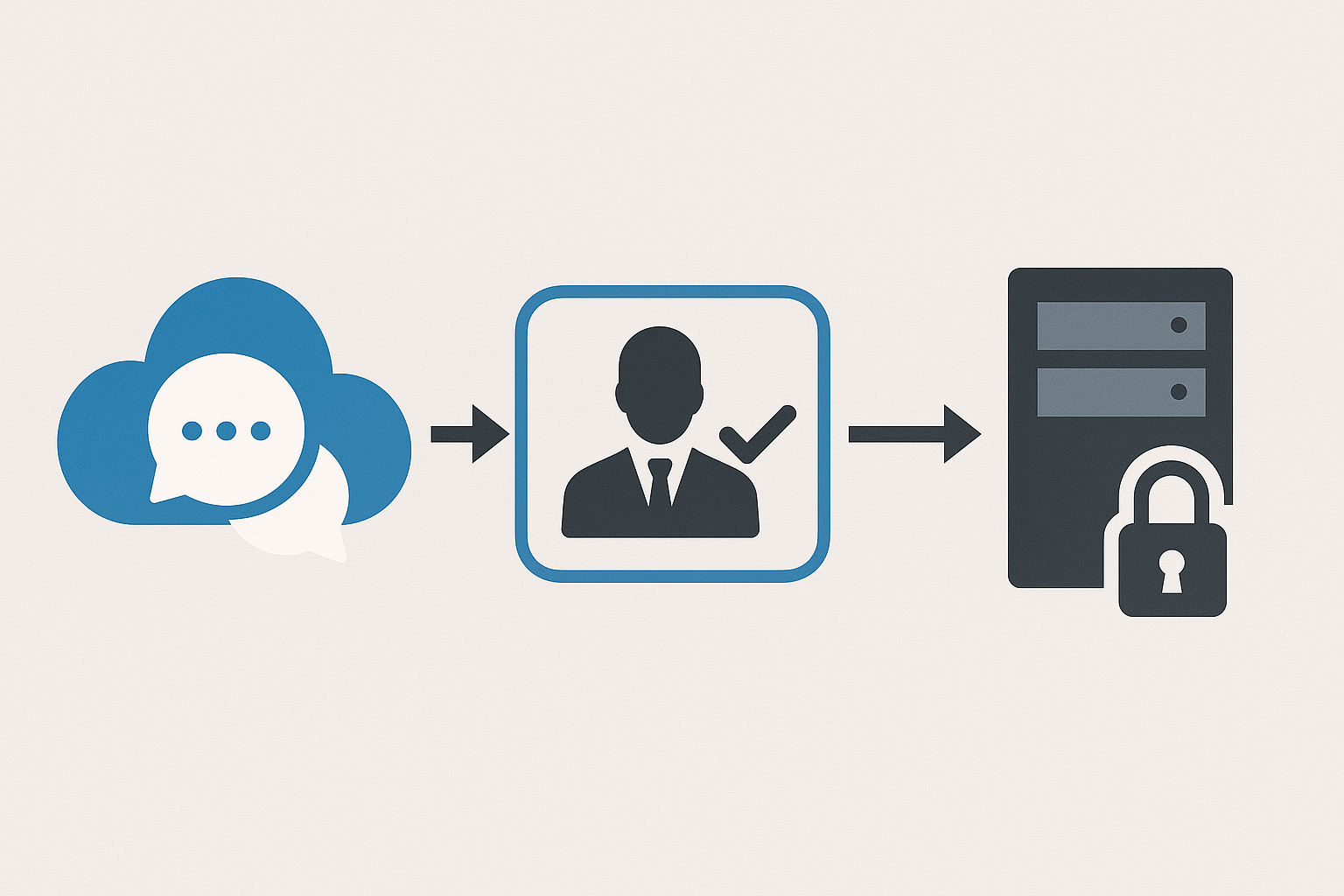
For most companies, the practical shortlist is straightforward: choose Microsoft Teams if Microsoft 365 and Entra ID already govern employee access, Slack for integration-heavy collaboration, Google Chat for a Google Workspace-centered organization, and Mattermost or a Matrix-based deployment when infrastructure and data-location control are the priority. Rocket.Chat is particularly worth considering when internal messaging and governed customer conversations must share one platform.
Telegram can support groups, channels, bots, and administrator roles, but it was not designed around the full employee lifecycle. Companies that need centralized identity management, automatic offboarding, retention policies, legal hold, or controlled exports should evaluate workplace platforms rather than treating stronger group moderation as sufficient administration.
Why Telegram becomes difficult to govern at company scale
The central issue is not whether Telegram can protect messages or support large conversations. It is whether the company can consistently control accounts, access, records, and policy enforcement.
Telegram accounts are generally associated with individuals and phone numbers rather than identities created and owned through a company directory. If an employee leaves, removing that person from known groups does not provide the same control as disabling one company identity and revoking access across every workspace and device.
Records management is another important difference. Regulated organizations may need to retain certain conversations for a defined period, suspend deletion for a legal matter, search records, and produce an auditable export. Those requirements call for system-level retention and discovery controls, not informal instructions telling employees to preserve messages.
Encryption also requires precise comparison. Telegram’s regular cloud chats and its end-to-end encrypted Secret Chats use different security models. End-to-end encryption can reduce a service operator’s access to message content, but it may also limit centralized discovery, moderation, and archival workflows. A company therefore needs an explicit policy about which communications must be private from infrastructure operators and which must remain available to authorized compliance personnel.
A practical comparison of the leading alternatives
| Platform | Strongest fit | Main governance advantage | Primary trade-off |
|---|---|---|---|
| Microsoft Teams | Microsoft 365 organizations | Entra ID identity controls and integration with Microsoft Purview governance tools | Licensing and configuration can be complex |
| Slack | Integration-heavy teams | Central workspace administration, enterprise identity features, and extensive application integrations | Advanced governance features depend heavily on plan and deployment design |
| Google Chat | Google Workspace organizations | Workspace-managed identities and Google Vault support in applicable editions | Best value usually depends on already using the Google ecosystem |
| Mattermost | Organizations seeking a controlled or self-hosted environment | Deployment flexibility combined with enterprise administration options | The organization may assume substantial operating responsibility |
| Rocket.Chat | Internal collaboration combined with customer-facing conversations | Self-managed deployment options and omnichannel communication capabilities | Governance across internal and external conversations needs careful testing |
| Matrix with Element or another client | Organizations prioritizing an open protocol and architectural control | Choice of server, clients, deployment model, and federation policy | Architecture and operations can be more demanding |
Microsoft Teams: the clearest choice for Microsoft-centered companies
Teams is usually the lowest-friction replacement when employee identities, devices, and documents already run through Microsoft 365. Entra ID can centralize authentication, conditional access, group membership, and account deactivation. Depending on licensing and configuration, Microsoft Purview can add retention, eDiscovery, auditing, and legal-hold functions.
This does not make compliance automatic. Before selecting a license, map each required Purview function—such as retention, eDiscovery, or legal hold—to the exact plan and confirm that policies cover private chats, channel messages, shared channels, and guest activity as intended.
Slack: strong collaboration with mature enterprise administration
Slack is a strong candidate when application integrations and cross-functional collaboration are more important than controlling the underlying infrastructure. Enterprise offerings can support centralized authentication, automated provisioning, administrative roles, retention controls, audit information, and discovery workflows.
Its main limitation for control-focused buyers is the managed-service model. The company controls workspace policy and access, but Slack operates the service. Buyers should also examine how external organizations are handled through shared channels, because retention and administrative authority can differ across organizational boundaries.
Google Chat: a sensible extension of Google Workspace
Google Chat is often the most economical organizational fit for companies already managing users in Google Workspace. Administrators can manage access through company accounts, while Google Vault can support retention, holds, search, and export for Chat data in supported editions and configurations.
The buying decision should focus on coverage rather than brand familiarity. Confirm how direct messages, spaces, threaded conversations, edited content, and external participants interact with the organization’s Vault and access policies.
Mattermost: more infrastructure control without starting from scratch
Mattermost is designed for organizational collaboration and can be deployed in environments controlled by the customer. It is preferable to managed alternatives when data location, restricted networks, custom infrastructure, or integration with internal systems is a firm requirement.
Enterprise buyers should verify three capabilities in the proposed edition: integration with the company identity provider, enforceable message-retention policies, and audit or compliance exports suitable for the organization’s review process. Mattermost can provide greater deployment control than Teams or Slack, but the customer may become responsible for upgrades, monitoring, backups, capacity planning, and incident response.
Rocket.Chat: useful when conversations extend beyond employees
Rocket.Chat offers cloud and self-managed approaches, with capabilities aimed at both team collaboration and omnichannel customer communication. That makes it distinctive for organizations that want employees to handle website, support, or other external conversations alongside internal messaging.
Compared with Mattermost, Rocket.Chat may deserve earlier consideration when governed external communication is a central requirement rather than an occasional guest-access need. A useful buying test is whether customer conversations can be identified, retained, searched, exported, and access-controlled under the same records policy as internal channels.
Matrix and Element: architectural choice with a higher design burden
Matrix is an open communication protocol rather than a single hosted messaging service. Organizations can operate a Matrix homeserver, use a managed deployment, select compatible clients such as Element, and decide whether to permit federation with other servers.
This flexibility can reduce dependence on one application vendor, but it introduces architectural decisions that managed platforms largely hide. Administrators must define federation rules, identity integration, encryption policy, retention behavior, backups, moderation, and upgrade responsibility. Matrix is most attractive when protocol choice and infrastructure control justify that additional work—not simply because it can be self-hosted.
Use four decision gates instead of comparing feature lists
1. Can the company terminate access through one identity?
Imagine an employee leaving with a phone, laptop, and active browser sessions. If disabling that person in the identity provider does not quickly remove access from every workspace and revoke sessions where required, the platform leaves a significant offboarding gap. Test single sign-on, automated provisioning, deprovisioning, session revocation, and guest expiration in a trial environment.
2. Can records be retained and placed on hold?
Define which conversations are business records, how long they must be retained, who can search them, and whether deletion must sometimes be suspended. Retention controls determine normal record life; legal hold preserves relevant information despite normal deletion schedules. An export function alone is not a substitute for either capability.
3. Is a managed service acceptable?
If established cloud services satisfy the organization’s contractual, data-location, and risk requirements, Teams, Slack, or Google Chat will usually reduce operating burden. If the company must select the hosting environment, isolate the service, or run it on a restricted network, Mattermost, Rocket.Chat, or a Matrix-based system may be more appropriate.
Self-hosting increases control over infrastructure, but it does not automatically improve security or privacy. The organization must secure the operating system and database, install updates, monitor suspicious activity, protect backups, test recovery, and maintain enough expertise to respond when the service fails.
4. Can the organization operate its preferred model reliably?
A theoretically ideal self-hosted system can become the riskier choice if nobody owns patching, monitoring, backup testing, and emergency support. Conversely, a managed platform may be unsuitable when contractual or technical requirements demand controls that the provider cannot offer. Compare total responsibility, not just subscription prices.
Run a governance pilot before migrating
A pilot should test administrative events rather than merely asking whether employees like the interface. Create and disable a user, revoke an active session, invite and remove a guest, apply a retention rule, retrieve an audit event, export a sample record, and restore the service or its data according to the proposed recovery process.
The final choice can then be decisive. Microsoft-native companies should normally begin with Teams, while Google Workspace organizations should evaluate Google Chat before adding another identity and records system. Slack is the leading managed candidate when integrations and cross-company collaboration drive the decision. For self-hosted deployments, Mattermost offers a business-oriented starting point, Rocket.Chat stands out when external conversations matter, and Matrix suits organizations prepared to manage a more flexible communication architecture.