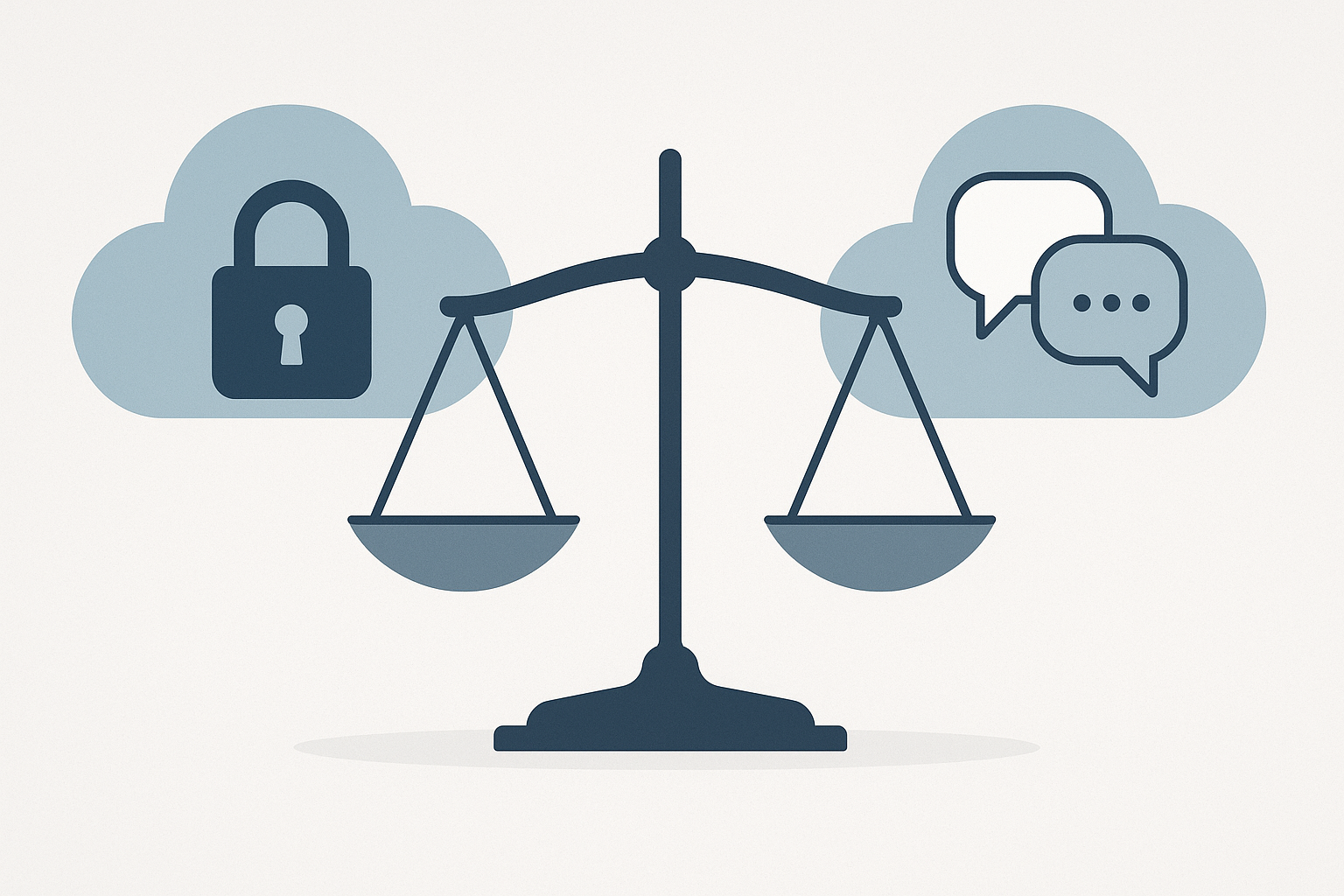
Imagine HR must preserve an employee’s chat history for a legal hold, but the messaging service is designed so that neither the provider nor an administrator can decrypt it. That conflict captures the challenge of replacing Signal at work: strong end-to-end encryption protects conversations, while business governance often requires centralized identity, retention, investigation, and recovery controls.
Signal is excellent for private communication, but it is not designed as a full enterprise messaging environment. Organizations generally need managed accounts, reliable offboarding, policy enforcement, business records controls, and support for lost devices. The best alternative depends on whether the priority is protecting messages from the service operator, maintaining centrally accessible business records, or separating conversations according to their sensitivity.
Why Signal becomes difficult to govern at work
Signal’s end-to-end encryption means message content is readable only on participating devices. This limits the risk that a service operator, infrastructure administrator, or compromised server can expose readable conversations.
That protection also limits administrative access. Signal does not provide the kind of organization-wide account directory, retention administration, legal hold, audit, and content export commonly expected from enterprise collaboration platforms. Registration also remains associated with a phone number, even though usernames can reduce the need to disclose that number to contacts.
These limitations matter during ordinary business events, not just investigations. A company must decide what happens when an employee leaves, loses a device, changes roles, needs access restored, or has relevant messages on a personally controlled phone.
Three types of alternative
Enterprise-oriented end-to-end encrypted messaging
Wire and Threema Work add organizational administration to messaging built around end-to-end encryption. They can provide stronger account and policy controls than a consumer application, but administrators generally do not receive unrestricted access to everyone’s encrypted history merely because they manage the organization.
Wire emphasizes managed business communication with enterprise identity features and multiple deployment choices, including vendor-hosted and privately deployed options. Threema Work provides centrally managed business identities and policies through a management console, while Threema OnPrem is the related option for organizations that need to operate the service in their own environment.
Self-hosted or managed Matrix messaging
Element is a prominent client and enterprise offering built around the Matrix communication protocol. Organizations can use a managed deployment or operate Element and a Matrix server in infrastructure they control. Matrix also supports federation, allowing separate servers to communicate when policy permits.
This approach offers considerable control over hosting, identity integration, federation, and data location. It also creates architectural choices that must be managed carefully. End-to-end encrypted room content remains ciphertext on the server, while usable history and recovery depend on clients, encryption keys, and configured secure backup mechanisms.
Governance-first collaboration platforms
Microsoft Teams, Slack, and Google Chat follow a different model. They generally emphasize centrally managed business records, retention, search, auditing, legal hold, and administrative discovery rather than default end-to-end encryption for chat messages.
An organization may reasonably select one of these platforms when investigations, regulated recordkeeping, centralized search, and integration with an existing productivity suite matter more than preventing the service operator from having technical access to message content. Messages can still be encrypted in transit and at rest, but that is not the same as end-to-end encryption.
How Wire, Threema Work, and Element differ
| Criterion | Wire | Threema Work | Element and Matrix |
|---|---|---|---|
| Identity management | Enterprise account administration and directory integration are available, depending on deployment and plan. | Business identities, contacts, groups, and policies can be managed through the administration environment and supported management interfaces. | Can integrate with organizational identity systems; exact capabilities depend on the Element offering and server configuration. |
| Key and history recovery | Recovery must be evaluated separately from account reset. Administrative control does not automatically provide readable encrypted history. | Device and backup policies require planning; administrators do not ordinarily gain a universal plaintext archive of conversations. | Supports encrypted key backup and recovery workflows, but users and administrators must manage recovery securely. |
| Retention | Policy and legal-hold requirements should be checked against the selected deployment and encryption workflow. | Central policy controls do not necessarily create a searchable archive of encrypted message content. | Servers can control stored event data, but deleting ciphertext and eliminating every client-side copy are different tasks. |
| Deployment | Managed cloud and private deployment options are available. | Threema Work is managed; Threema OnPrem addresses self-hosted requirements. | Managed cloud, private deployment, and self-hosting are available. |
| External access | Supports business communication with external participants, subject to configured controls. | External communication can be governed through contacts, IDs, and administrative policies. | Federation and guest or external access can be allowed, restricted, or disabled according to architecture and policy. |
| Administrative exports | Do not assume administrators can export all encrypted conversations in readable form. | Central management is not equivalent to centralized plaintext content export. | Server database access does not decrypt end-to-end encrypted rooms; readable export requires authorized keys or a separate archival design. |
Product editions and enterprise features change, so procurement teams should verify the current documentation and contract. In particular, “supports retention” may mean deleting data after a period, preserving selected records, or making content searchable by authorized reviewers. Those are distinct capabilities.
End-to-end encryption does not cover every workplace risk
Business end-to-end encryption protects message content while it travels through and rests on the messaging service. It does not protect a conversation after an authorized user opens it on a compromised device, copies it to another application, takes a screenshot, or exports it.
It also does not necessarily conceal metadata such as account identifiers, group membership, device information, connection times, or message-routing details. The amount retained depends on the platform and deployment.
Self-hosting changes who controls the server, but it does not remove these endpoint risks. It also transfers responsibility for patching, monitoring, backups, availability, key services, and incident response to the organization or its managed provider.
Test realistic business events before choosing
A feature checklist can look convincing while missing the workflows that determine whether secure workplace messaging is sustainable. A pilot should test at least six events:
- A new employee joins: Can IT create the identity, assign groups, enforce authentication, and provide access without sharing unmanaged credentials?
- A device is lost: Can access be revoked promptly? Can the user recover necessary conversations without giving administrators a universal decryption capability?
- An employee leaves: Can the organization disable the account, remove managed data where supported, transfer responsibilities, and prevent continued access from enrolled devices?
- An investigation begins: Can authorized reviewers preserve and retrieve the records they are legally permitted or required to access? If not, is that limitation accepted and documented?
- The service is unavailable: Who restores it, how are encryption keys protected, and what communication method remains available during the outage?
- The organization migrates: Can it export accounts, contacts, rooms, and required records in usable formats? Encrypted database files alone may not provide practical portability.
A split model may resolve the encryption-governance conflict
Some organizations should not force every conversation into the same trust model. A governance-first platform can hold routine operational discussions and official business records, while an end-to-end encrypted system handles narrowly defined sensitive communication.
This only works when policy is clear. Employees need to know which system should contain approvals, customer commitments, personnel records, incident discussions, and temporary confidential exchanges. Otherwise, the split creates fragmented records and encourages users to make their own inconsistent decisions.
The practical choice is therefore not simply “Signal versus another secure messenger.” Wire may suit an organization wanting enterprise-oriented encrypted communication with deployment flexibility. Threema Work may appeal to teams prioritizing managed business identities and privacy-focused administration, with Threema OnPrem available for greater infrastructure control. Element may fit organizations that value Matrix interoperability, federation controls, and self-hosted or managed deployment choices. Teams, Slack, or Google Chat may be more appropriate when centralized retention and discovery are non-negotiable.
Before selecting a platform, decide whose access the encryption must prevent and which business records the organization must still recover. That decision narrows the field more effectively than comparing encryption labels alone.