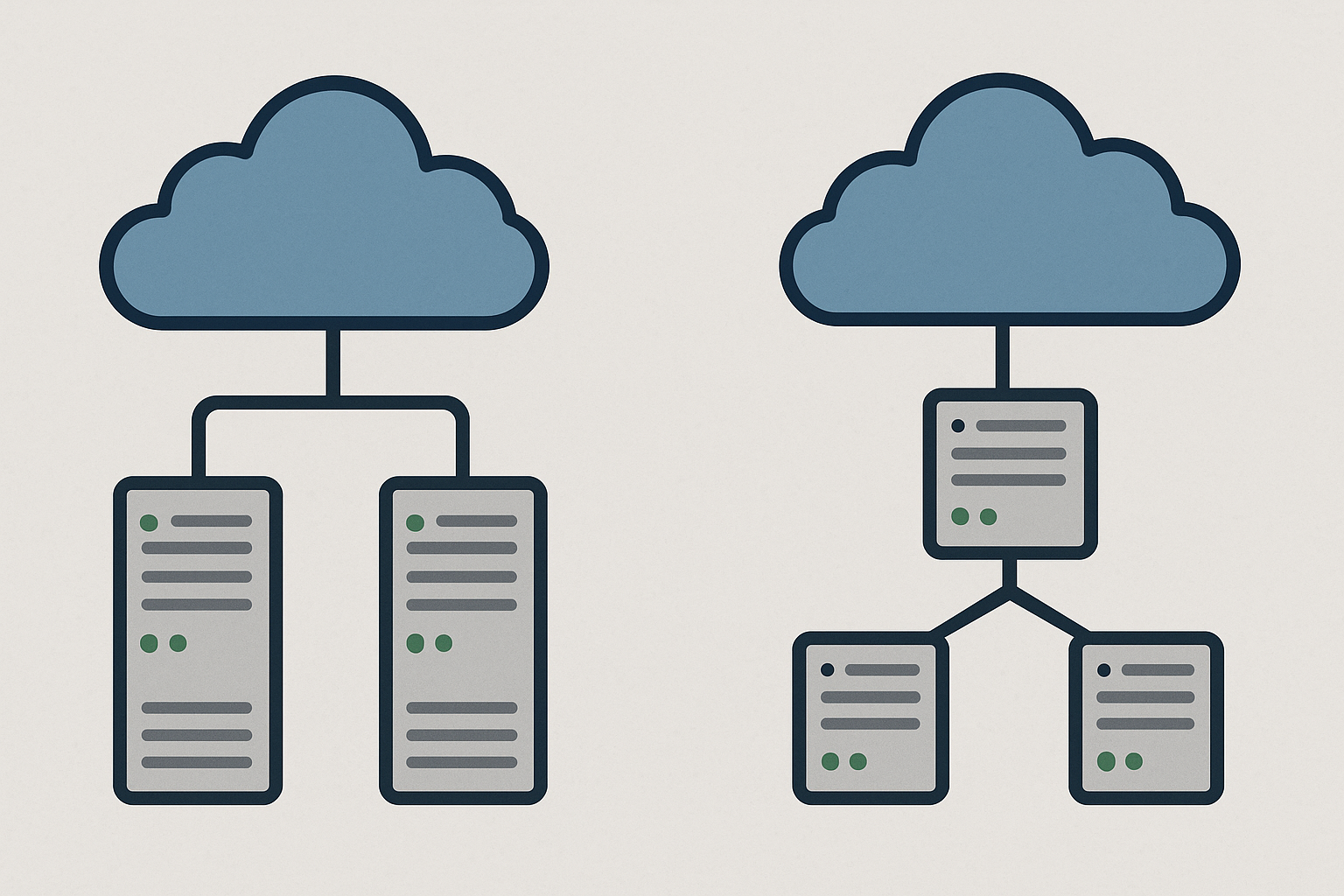
High availability for self-hosted chat comes from removing the failures most likely to stop service, not from duplicating every component. A practical design usually combines multiple chat application instances, a redundant entry point, protected shared data, monitoring, and a tested recovery process. The exact pattern should reflect how long the organization can tolerate an outage and how much message data it can afford to lose.
Start with availability targets, not server counts
“Highly available” is not a complete technical requirement. A company that can tolerate a one-hour interruption needs a different design from an organization that depends on chat for round-the-clock operations.
Define two recovery objectives before choosing an architecture:
- Recovery time objective (RTO): how quickly chat service should be restored after a failure.
- Recovery point objective (RPO): how much recent data the organization can accept losing, measured in time.
These targets affect database replication, backup frequency, spare capacity, network design, and whether failover must be automatic. They also provide a practical basis for deciding whether added complexity is worth its cost.
Identify the components that can stop the service
A self-hosted chat system is rarely just one application process. It normally depends on several components:
- an entry point such as a load balancer or reverse proxy;
- one or more chat application instances;
- a database containing accounts, channels, messages, and settings;
- shared storage for uploaded files and other attachments;
- supporting services such as a cache, search engine, or message queue;
- DNS, certificates, identity services, networking, and power;
- monitoring, backups, and administrative access.
Adding a second application server does not create meaningful availability if both servers depend on one unprotected database, one storage volume, or one physical host. Architecture reviews should follow the full user request from device to data and identify every single point of failure.
Pattern 1: A recoverable single-server deployment
The simplest pattern runs the application and its dependencies on one server or virtual machine. It is not truly highly available, because a host failure can stop the entire service. However, it can be made reasonably recoverable for smaller organizations with modest continuity requirements.
A sound version of this pattern includes automated off-host backups, infrastructure documentation, configuration management, monitoring, and a tested restoration procedure. A prepared replacement virtual machine or image can reduce recovery time.
This approach may be appropriate when brief outages are acceptable and operational simplicity matters more than automatic failover. It is usually better to operate one well-maintained server with verified backups than a complicated cluster that nobody understands or tests.
Pattern 2: Active application nodes behind a load balancer
A common next step is to run two or more application instances behind a load balancer. The load balancer checks instance health and directs users only to working nodes. Maintenance can then be performed on one node while another continues serving users.
The messaging platform must support this type of clustered deployment. Some applications store session information or real-time connection state locally. They may require shared session storage, specific clustering features, or temporary connection affinity, often called sticky sessions. WebSocket connections may also need explicit support in the proxy configuration.
The load balancer itself must not become the new single point of failure. Organizations can use a redundant pair, a highly available network appliance, or a managed load-balancing service where the chosen deployment model permits it.
Pattern 3: Protect the database and shared files
The database is often the most important availability component because application nodes can usually be rebuilt more easily than message history and account data.
A typical database design uses a primary database and one or more replicas. If the primary fails, a replica can be promoted. Promotion may be manual or automated, depending on the database technology, platform requirements, and operational maturity of the organization.
Replication is not the same as backup. Accidental deletion, application errors, or malicious changes may be copied immediately to every replica. Backups provide a separate recovery path and should be stored outside the failure domain of the live system.
Uploaded files also need shared, resilient storage. If each application node keeps attachments on its own local disk, users may see different files depending on which node handles a request. Suitable options can include redundant network storage or compatible object storage, provided the messaging platform supports the selected method.
Pattern 4: Active-passive service with a warm standby
An active-passive design keeps one environment serving users and a second environment ready to take over. The standby may run continuously or be started during an incident. Data and configuration must be replicated or restored so that the standby is usable.
This pattern can be simpler than operating every component in an active cluster. It can also isolate the standby from some local hardware failures. The trade-off is a longer recovery time, particularly when staff must promote databases, change routing, or validate the standby manually.
Active-passive designs work best with a documented failover checklist. The checklist should identify who declares an incident, how traffic is redirected, how data consistency is checked, and how the organization returns to normal operation after the failed environment is repaired.
Pattern 5: A second site for major disruptions
Organizations that cannot depend on one building, data center, or cloud region may maintain a secondary site. This can protect against prolonged power, network, facility, or regional failures.
Multi-site operation adds substantial complexity. Network latency can affect synchronous database replication, while asynchronous replication may lose the newest transactions during an abrupt failover. Automated failover also needs safeguards against split brain, where both sites believe they are active and accept conflicting changes.
For many businesses, a primary site with a warm disaster-recovery environment is more manageable than two simultaneously active sites. Geographic redundancy should be introduced only after local failover, backup restoration, monitoring, and operating procedures are reliable.
A practical progression for most organizations
| Pattern | Suitable situation | Main limitation |
|---|---|---|
| Recoverable single server | Short outages are acceptable and administration must remain simple | Hardware or host failure stops service |
| Multiple application nodes | Application maintenance and node failures should not interrupt chat | Shared database and storage still require protection |
| Redundant application, database, and storage layers | Chat is operationally important and local component failures should be tolerated | Greater monitoring and administration requirements |
| Warm standby site | The organization needs recovery from facility or regional disruption | Failover may involve delay and possible recent data loss |
Operational practices determine whether failover works
Redundant infrastructure provides little value if failures remain undetected or recovery actions have never been tested. Monitoring should cover service availability, database health, replication delay, storage capacity, certificate expiration, queue backlogs, and the ability to send and receive messages—not merely whether servers respond to network checks.
Planned tests should include taking an application node offline, failing over the database, restoring attachments, and recovering the system from backup. Tests should verify mobile and desktop connections, authentication, notifications, integrations, and message delivery where those functions are important.
Capacity also matters during a failure. If two application nodes normally operate near their limits, losing one may leave the remaining node unable to handle the workload. Each layer needs enough spare capacity to carry the expected service during maintenance or failover.
Finally, greater control brings direct responsibility for patching, certificate management, access control, monitoring, backups, and incident response. A managed private deployment can sometimes meet continuity goals with less internal administration, while self-management may suit organizations with the necessary infrastructure skills.
The simplest reliable design is the one that meets documented recovery targets and can be operated confidently. Protect the database and shared files first, remove obvious single points of failure, and test recovery before adding multi-site complexity. High availability is demonstrated by successful failover and restoration—not by the number of servers in the architecture diagram.